Rebuilding the Map: Inside the Race to Replace GPS
The signal that runs the modern world is weaker than a light bulb and easier to fake than an email. Meet the engineers building its successor.

By Jonas Feld, Technology Reporter
July 19, 2026
8 min read
The signal your phone is listening to right now left a satellite twenty thousand kilometers up and arrived at your pocket with roughly the power of a night-light seen from across a continent. It timestamps your runs, lands airliners, settles stock trades, synchronizes power grids, and tells the delivery driver you are the third house on the left. It is, by most engineering assessments, the single most successful utility ever launched — and among the most fragile.
Fragile because faint, and faint because far. A signal that weak can be drowned out by a jammer the size of a paperback, or — the scenario that actually keeps the engineers up — imitated. Spoofing, the art of whispering a false position into a receiver, has migrated in a decade from laboratory demonstration to something ships' captains file routine reports about. The world built itself on a whisper, and the whisper can lie.
The layered map
The replacement, it turns out, is not one thing. Nobody serious wants to rebuild the constellation as-is, only louder. The plan taking shape across a half-dozen agencies and a swarm of startups is a layered one, on the theory that no two layers fail the same way.
- Low-orbit swarms. Navigation satellites at one-twentieth the altitude, delivering a signal hundreds of times stronger — harder to jam, refreshed every few years, and cheap enough to lose.
- Ground truth. A revival of terrestrial beacons — the eLoran lineage — whose long-wave signal punches through buildings and cannot plausibly be faked from a parking lot.
- Self-reliance. Quantum inertial sensors that let a ship or aircraft simply remember where it is, drift-free, for hours after every external signal disappears.
GPS taught the world to outsource its sense of place. The next system's first job is teaching machines to be suspicious.
A navigation-systems architect, cleanroom badge still clipped on
The clock is the product
What outsiders miss, the engineers say, is that position was always the side effect. The satellites sell time — nanosecond-grade, planet-wide, free — and modern civilization quietly rebuilt itself around that clock. Banks stamp trades with it; cell towers breathe by it; the grid balances against it. The scariest failure drills are not the ones where the map goes blank, but the ones where the clocks merely disagree.
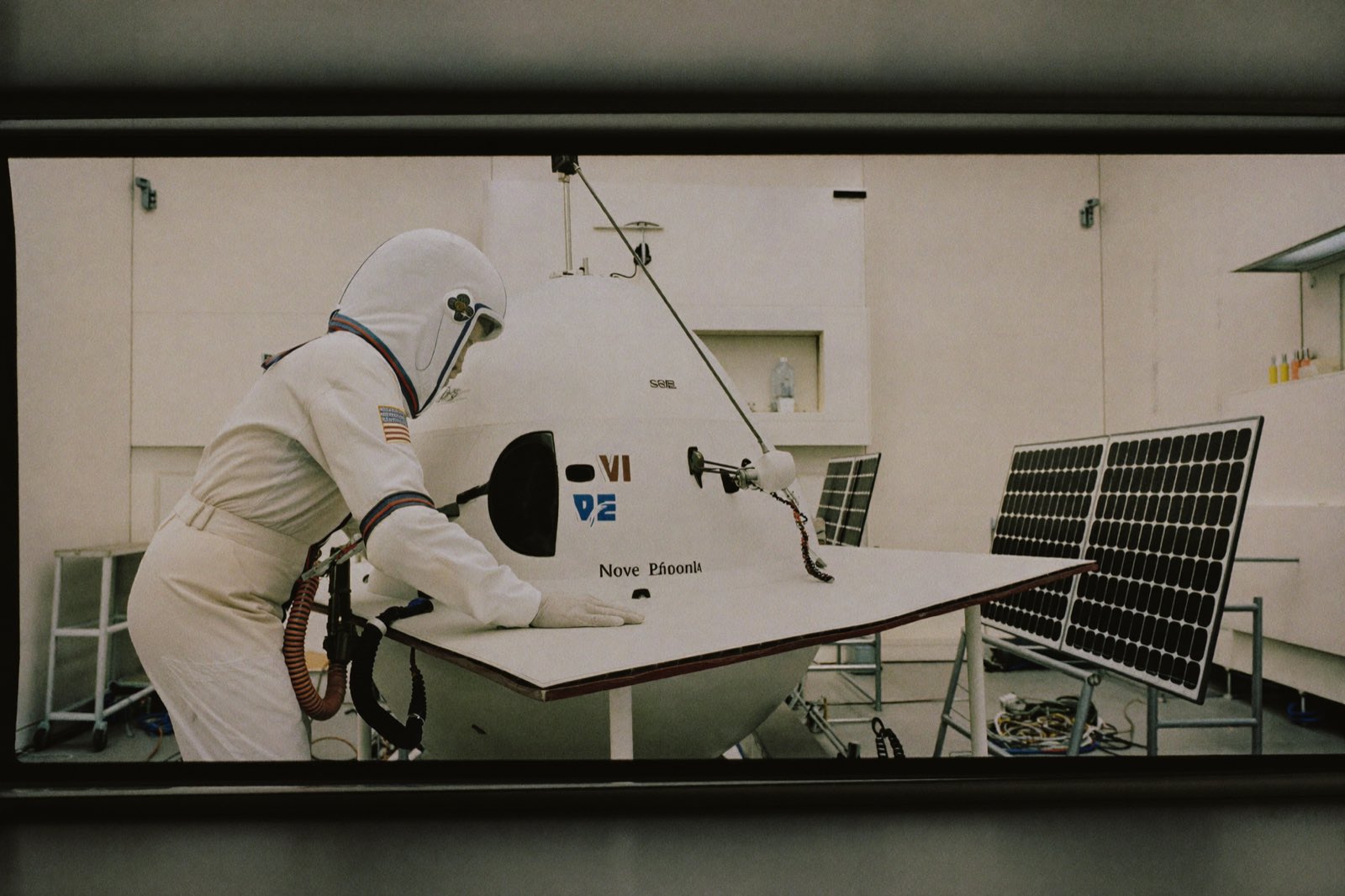
In the clean room, the next answer to that problem sits under tent lighting, solar wings folded like a moth's, while technicians in bunny suits torque bolts in a printed sequence. It will fly in eighteen months, one node of a mesh designed on a blunt assumption its predecessor never made: that someone, somewhere, will always be lying to it. The engineers do not call this pessimism. They call it, at last, a map that checks its own work.